
My article is up on jnmjournal.com regarding the gaming system called Ouya!
http://www.jnmjournal.com/ouya-gaming-system-the-kickstarter-wonderboy/
My article is up on jnmjournal.com regarding the gaming system called Ouya!
http://www.jnmjournal.com/ouya-gaming-system-the-kickstarter-wonderboy/
My article on the latest technology has finally been posted! I apologize for the photos not being in the right place. There was some formatting issues with the publishers.
As part of an in class writing exercise I had to write a short non-fiction piece from a sympathetic and a non sympathetic perspective. It’s an exercise for those of us writing the long form pieces in our advanced writing class specifically. Here is what I wrote. Names have been changed.
Character Development Writing Exercise
Sympathetic Perspective
Mark heard the excitement of the dogs as his mom came home. The excitement quickly turned to growling. Within seconds, aggression broke out and the two puppies were attacking each other. Mark hastily made his way to the dogfight. He stood over them. He grabbed one by the hind legs, pulling the pup away from the other. This usually worked, but for some reason, they were still going at it. He let go, and the fight continued. He started getting frustrated. His face contorted with anger. He was getting fed up with the pups fighting. He didn’t have the money to get both pups neutered, and this was the third fight that had happened so far today. Add the lack of sleep on top of it all; having to clean up after everyone else’s messes, baking and cooking for the family every day, and the job search coming up with nothing yet again, Mark had had enough. He grabbed both pups by the scruff of their neck and held them at arms length away from each other, as they growled and tried to break free.
“THAT’S ENOUGH!” He yelled, as his mom stood idly by. “I’VE HAD ENOUGH OF THE FIGHTING! BOTH OF YOU ARE DONE!”
He waited until they were both calm, and then let them go.
Non-Sympathetic Perspective
Amy came home and heard the sounds of the TV from the living room. She decided she would join her family – whoever happened to be there. She grabbed her laptop from her bag and took a seat at the kitchen table. Remembering that Mark – her brother – had been baking, she quickly ran to the basement to grab the chocolate pecan squares from the fridge.
She brought them up and placed them on the table, grabbing a few plates for herself, Mark, and her mom. Mark came over as she placed three squares on her plate.
“You’re having three?” He asked, smiling.
“Well everything you make goes so fast, I want to make sure I get more than one.”
“So it doesn’t make a difference that I do so much around the house, but I don’t make enough food for people. Thanks,” he said angrily. He sat down on the couch, crossing his arms, clearly agitated.
“That’s not what I meant!” she exclaimed. She tried to speak calmer, lowering her voice. “I mean everything you make is so good that people just devour it. It gets eaten so fast. It’s a compliment.”
“No it’s not, it’s an insult. Apparently there’s no way of pleasing anyone in this house.”
“Forget it,” said Amy in irritation. She grabbed her plate and her laptop and isolated herself in her room.
Social media can give news organizations an advantage when covering conflicts and making people more aware.
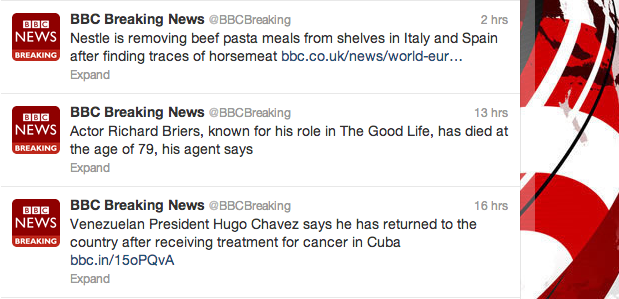
BBC’s Breaking News Twitter feed.
When it comes to news organizations getting involved in social media by tweeting breaking news or posting articles on other sites to get the most recent information out there on a conflict; then it becomes beneficial to those seeking that information. It is a huge advantage for major news sites to have the ability to get their stories out there in a multitude of ways, because odds are, people may not watch the news, but they’re likely to click a link that a friend has posted about some new development on a conflict overseas. Using social media to post articles is an acceptable way to promote the news and cover it effectively.
Lisa Knap, a previously employed reporter for CH News, says that she looks “at twitter all the time for news… People are getting news when and how they can… I think it’s a great tool for people to still get your reporters messages out,” and that social media “has a real use and a real purpose, in that it can greatly assist in [that] situation.”
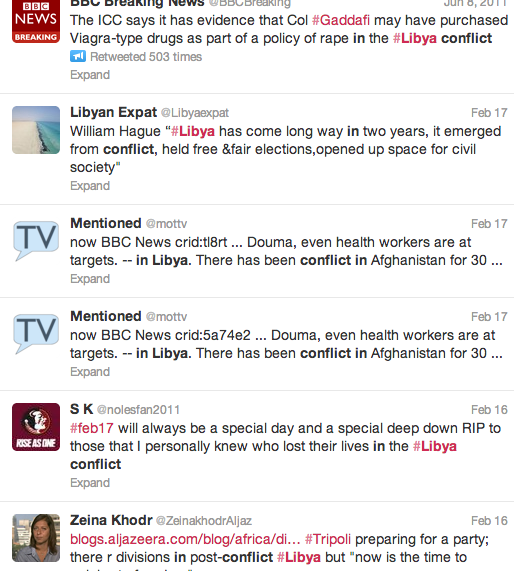
Tweets regarding the conflict in Libya.
Lisa refers to a situation when the conflict in Libya was occurring and information was difficult to come by. She says that communication was shut down for a lot of the reporters, and news organizations had to turn to social media to get further information on the issue. “We were basically putting that forward on our own media and we did couch it saying that it was through social media and had not been verified. The information turned out to be true… If it weren’t for social media, it never would’ve gotten out.” She prefaces that it’s only when communications are shut down that turning to social media can give an idea as to what is going on during a conflict.

Updates on the CBC Facebook page.
On the BBC news site, readers can see a comments section where the organization asks people who are in the conflicted country to let them know what is going on. The BBC is involving those in the countries to be aware and tell their stories – by doing this, they are incorporating a human interest to the story, and getting society more involved in the issue. At the bottom of every article on the CBC and the BBC websites, are icons to allow readers to share the news through social networking. These seem like further steps to help spread the word and hope that people will become more aware.
There are disadvantages to social media and that primarily comes with the spreading of false information. An individual can take a story and turn it into something else, effectively taking out the truth behind the conflict. This is a failure because there is no filtering of truth versus lies. In this case, it can be difficult to filter through the appropriate coverage of a conflict and what information is based off of lies. In this situation, it is up to the individual to pay attention to what they are reading about a conflict. If they choose to read articles from people who don’t have the most up to date information or listen to people who don’t have a proper conception of what is going on, then they will be fed inaccurate information. However, if they look at real coverage of an issue by a refutable organization, then they are more likely to receive the most accurate coverage on a conflict.
Social media has its advantages by allowing news organizations to promote their stories and spread information about a conflict. It can allow people to become more aware of what is going on in other countries, or even their own.
This is late, but I wrote an article covering the storm that hit Southern Ontario last week:
http://www.jnmjournal.com/edited-by-monica-a-snow-storm-approaches/
The infographic is made by yours truly.
Do you know what you’re going to do with your leftover pennies? There are several options out there. Some more creative than others.
Banks across Canada allow members to bring in their pennies in exchange for other forms of cash – nickels, dimes, quarters, loonies, toonies, and bills. The pennies go straight to the government where they melt down the copper, which helps them save $11 million annually according to articles from the Huffington Post and the CBC.
Others have more creative ways of using their pennies. Some people are holding onto them in hopes that the penny will be worth something some day. Others, according to an article on Canada.com, are using the pennies to make jewelry. According to the article, a woman from Halifax named Renee Gruszecki wanted to find a way of preserving the Canadian penny. Over the last year, Gruszecki has been making jewelry in commemoration of the penny, and in hopes it will help the save the penny from being cut entirely from circulation. She’s not the only one with this idea. Other women across the country are making rings, necklaces, and other forms of jewelry out of the penny.
With the phasing out of the penny, and the way that many Canadians are dealing with it, one has to ask: does it really matter in the first place? An article in the Globe and Mail pointed out that the changes that come into effect with rounding a total to the nearest 5 cents wouldn’t actually change anything. Canadians won’t be losing money, nor will they be gaining money. Those of us who shop using a debit or credit card will not be affected. Instead, the price will be the same and won’t be rounded up or down. Considering the fact that it will take years for pennies to be completely removed from circulation, does it really make sense to try to commemorate the penny now? In an article in the Huffington Post, Jim Flaherty, Canada’s Minister of Finance, said the penny was a nuisance. In the same article, a retired Bank of Canada employee had designed a model proving that the penny should have been discontinued in 1982.
If Canadians are really set on preserving the penny and holding onto it, it would make sense that they should put a few pennies aside and remember it that way. It doesn’t seem necessary – albeit it is creative – to try to preserve the penny as jewelry and try to sell it.
This issue seems to be getting more attention than it deserves. There are many different opinions towards the discontinuation of the penny – preserve it, get rid of it, who cares? – that are getting a lot of media attention. On the Huffington Post’s website, you can find up to twelve articles pertaining to the penny. They even have an obituary for the penny, complete with a memorial playlist. The coverage almost seems unnecessary. Yes, the penny isn’t being made anymore; yes, stores won’t be giving it as change and have the option to not accept the penny at all, but there are still millions in circulation and all of this attention doesn’t seem necessary until the penny is literally gone. As it’s mentioned in many articles, including the Huffington Post and the CBC, the real death of the penny won’t happen for some time.
My article on the JNM Journal can be found here:
http://www.jnmjournal.com/sugar-daddy-its-an-acquired-taste/
It’s an article written on the recent response to “Sugar Daddy”, a website that helps connect men and women averaging the age of 40 with students who need financial help, all in return for either companionship or a relationship. Check it out!
Sarah Knowles. A bright smile. A booming voice. A personality that makes you feel as care free as she is. Someone who could stay in school forever – teaching that is – and travel the world, and would be happy just to do that.
In a recent interview on her travels, Sarah told me about the different countries she’s travelled to. Some she went to with friends and families, and others she traversed on her own, unsure as to what to expect from the foreign country, but excited to get started, meet new people, and take in every gorgeous site there is to see.
Some of the countries she’s been to include, Mexico, Australia, United States of America, France, Germany, Spain, China, Hong Kong, Equador, Italy, and Belize. Outside of Australia, Hong Kong, and Belize, Sarah travelled the others with family and friends. When travelling in these countries, she found travel guides helpful, but the ability to see whatever you want and go wherever you choose, has always been an adventure Sarah couldn’t refuse. She enjoys exploring the country and avoiding the typical “touristy” things. Being able to see what the locals do on a daily basis, and see the country for what it really is, is a goal Sarah has every time she takes her first steps in a different country.
Sarah’s next adventure is travelling through South East Asia to Bangkok, Thailand, Cambodia, and then Vietnam. She’s not concerned about language barriers as she’s taking a tour with English speaking people. She’s excited for this next adventure that will lead her back to her contract teaching job in Hong Kong.
She will continue to travel for most of her life, and maybe, she’ll settle down. At the end of the day, Sarah will go wherever she can, but always travel safely. She has not been in a country with major conflict, and has no intention of going to one. She prefers the safety of knowing she can go almost anywhere without threat to her life. It’s a comfort.
Liz Campbell is a freelance journalist, and has been most of her life. In the course of her career, she has travelled to dozens of different countries, most notably Malaysia, Norway, Wales, China, Hong Kong, Tanzania, and Botswana. She chose these countries to mention in the interview because of the experiences she had there, rather than their beauty or culture. She has covered stories ranging from cultural influences, to history, to conflict, to profile pieces. She has been a writer for more than half her life. She enjoys travelling with others, especially to help bounce ideas of how to cover certain topics. She’s travelled with other journalists, significant others, and on her own.
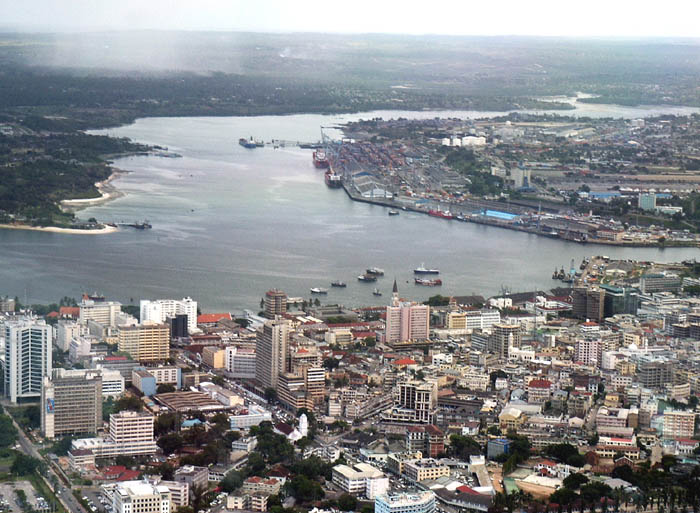
Dar Es Salaam, Tanzania
She speaks fondly of Tanzania when she spent two years there, over twenty years ago. She enjoyed her experience and even climbed Mt. Kilimanjaro and received a bouquet of everlasting flowers as a prize. When she and her boyfriend returned twenty-five years later, it wasn’t the same experience. She described the experience as being “vivid and disturbing”. Tanzania hadn’t changed much from the developing country it had been when she first visited. Instead, everything was much worse. There was an outbreak of AIDS, and a lot of violence and danger. Certain precautions had to be taken in the city, Dar Es Salaam; such as turning in before it got dark. It was a very dangerous city while they were there. There was conflict in Botswana as well. She found herself restricted from certain places when she was in Mexico due to rebel activity in Chiapas. However, her trip wasn’t affected in any real way due to these conflicts.

Everlasting Flowers
She has been on many press trips throughout her career. Sometimes she had a guide, and other times she was on her own to explore and talk to the people there. A guide was helpful to show her all of the places to go to, but it appears that she enjoys travelling without a guide. Guides didn’t necessarily limit her experiences, however, she found she discovered more about the countries and cities she was in by talking to the locals and having them show her what their culture and the beauty of their cities are all about.
Liz has always spoken fondly of her travels in other countries. It is not unusual for her to talk about the positive aspects of her trips. She rarely brings up the negative experiences. Would she recommend travelling to other countries and writing about them? Yes, she would in the end, but as always, you must be careful.
Science fiction has dealt with time travel and it’s implications for decades. It was popularized in television shows like Star Trek, and Doctor Who in the 1960’s.
The most recent sci-fi show that delves into the science and technology involved in time travel is Fringe.
Fringe is a show that deals with the realistic and terrifying truths about the world, and the experiments that took place in the 1960’s. Through out the cold war, ethics weren’t viewed in the same way and experiments went on morphing, destroying, and altering the human mind and body in a way that the human race had never seen or experienced before. Fringe delves into this idea of what would the world be like if these experiments had never ceased. What would happen if the scientists still continued their work and managed to mutate the human genes to become monstrous or even give them abilities that have never been seen before? Through multiple different elements, the Fringe team – Olivia Dunham, FBI agent, Peter Bishop, Walter Bishop, scientist who performed multiple experiments on children and people and is familiar with most forms of technology and experiments performed during the cold war, Astrid, FBI agent and assistant to Walter, and Broyles, the teams boss – explores these anomalies and place scientific explanation and solutions to the problems they face. But it’s not just these theories and ideas that Fringe explores. The show also deals with the heavier dilemmas of sci-fi.
The exploration into time travel and alternate dimensions influence many of the events that take place. The exploration and conceptualization of an alternate universe has caused a lot of rather strange events to take place that lead to a dystopian world. While time travel is dealt with in the earlier seasons, it’s not quite as big of an impact as it is in the final episodes of the series. Instead, in the beginning, the biggest dilemma was Walter crossing over to an alternate universe in order to save his son Peter, and the repercussions of this action. When time travel is first introduced it’s through the technology that has come from the Observers, who seem to move flawlessly and effortlessly through time and space. At first, no one knows who they are but they seem to randomly appear during the biggest events in Earth’s history. They are later revealed as the evolution of mankind. With time travel being explored in the final episodes, the Fringe team realizes the only way they can save the world from this “alien” take over is if they steal technology from the future and bring it back to 2036, so they can send a child observer named Michael and another human to the year 2176 when the Observers are first created.
The Observers are essentially the evolution of the human race who are devoid of emotion and run purely on logic. With the tech in their brains they are able to understand time lines and the way people think. They can also read minds and travel anywhere they want in time. Needless to say, they do not experience time or events in the same way humans do. So naturally, this concept of time travel is really quite amazing.
Time travel is seen as a positive and a negative. J.J. Abrams harnesses the possibility of what technology would exist in the next 20+ years based on theories and advances that are relevant now. Through this, the writers used everything they knew about time travel, which naturally provided some holes in the story and several questions to arise. But why wouldn’t it? Yes it makes sense for a series to wrap up without questions, but if our understanding and conception of time travel isn’t fully developed and therefore impossible to really truly grasp in reality, then why wouldn’t there be flaws? If we are unable to fully comprehend the reality of what time travel would do, and what is possible with time travel without the hundreds of theories that have been presented through other forms of sci-fi literature, then how can we guarantee and offer a happy ending with all loose ends tied up, when we can’t know for certain that everything we believe to be possible is actually possible?
These are several things that I believe the writers thought of when they wrote about time travel in the final episodes. It was difficult to determine whether or not time travel would be mastered in the future if the Observers were created in a different way – like the child, Michael, as opposed to the adults that took over the world. It is difficult to determine that Walter would have access to that kind of technology and be able to do anything about it, since he travelled with Michael to the future. It is difficult to guarantee whether or not Walter would have been wiped completely from time or when the Observers first invaded. So while the writer’s deal with these theories, there are still several things that through modern technology and science that wouldn’t be explainable. The writers seemed to try to ground as much of their reasoning in logic, science, and technology in a “what if?” scenario to give the viewers the most realistic explanation available for the ending of the story.
This is much more than most other sci-fi shows explore. Some take the theory of time travel and play around with it so much it almost loses logic. Some try their best to ground it in reality but take away the true concepts of time travel by making it almost impossible to manage and develop the technology for. Some merely use the theories available to us through years of sci-fi exploration and assume that re-using these ideas is enough. None of them seem to explore the more realistic and questioning logic that Fringe delves into.
 Rachel Sparling